
In cable selection, “braiding density” is a common technical parameter. This article introduces and distinguishes two key concepts: braiding density and coverage density.
What the marine cable industry generally refers to as “braiding density” is defined as coverage density in IEC 60092-350, with the standard English term coverage density. Chinese national standards (e.g. GB/T 9330) adopt the term braiding density. These terms belong to different standard systems with distinct definitions and calculation methods. Although the term “braiding density” is widely used in the industry, attention must be paid to distinguishing whether communication follows the Chinese national standard or IEC context.
1. Difference between Braiding Density and Coverage Density
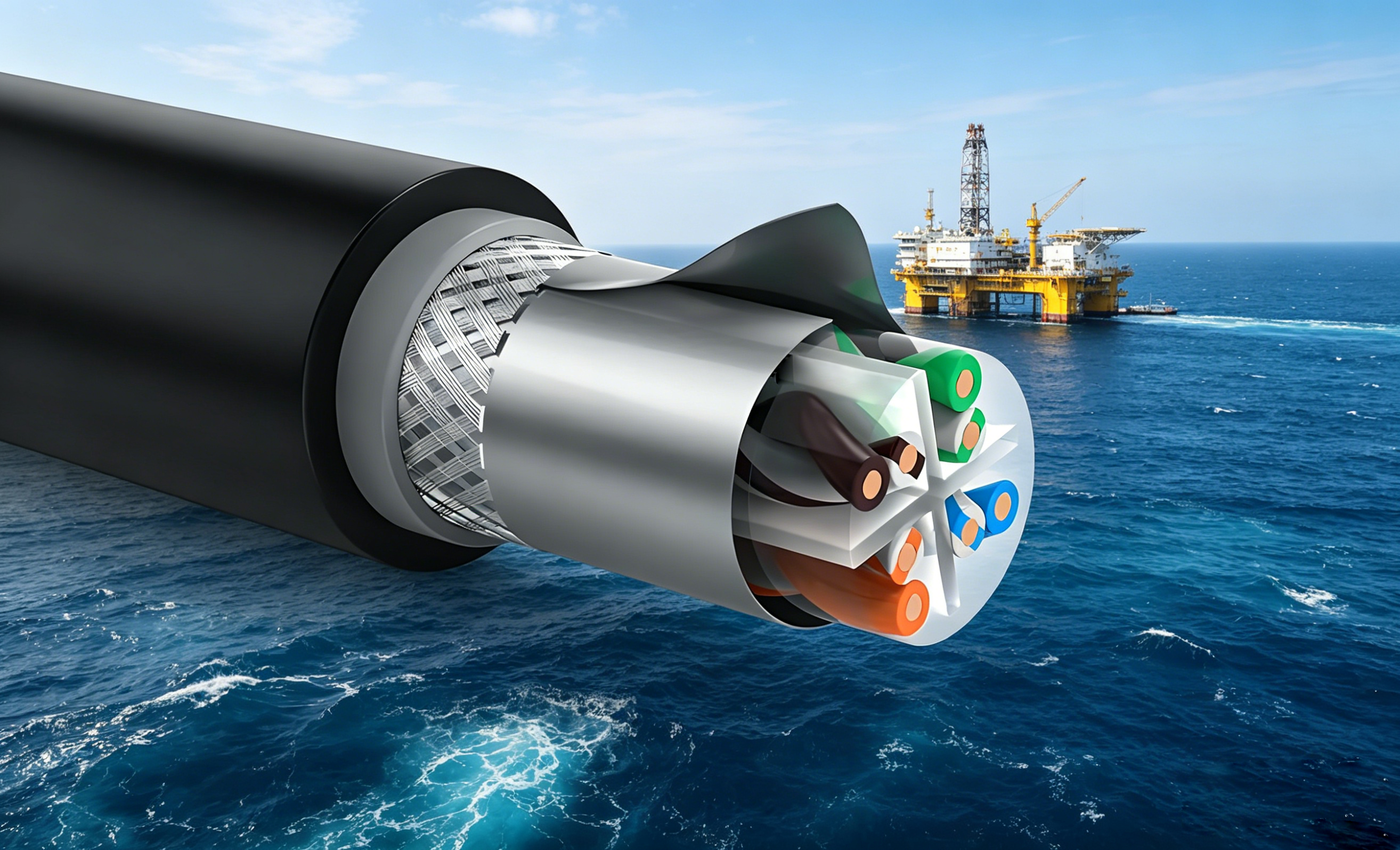
Braiding density and coverage density are not alternative expressions for one parameter; they are independent parameters defined under different standards.
| Item | Braiding Density | Coverage Density |
|---|---|---|
| English Term | Braid Density | Coverage Density |
| Governing Standard | GB/T 9330 and other Chinese national standards | IEC 60092-350 (International Standard) |
| Formula | \(P = (2p − p²) × 100\%\) | \(G = \frac{\pi F}{2} × 100\) |
| Physical Meaning | Percentage of cable surface covered by metallic wires | Multiplier of metal consumption relative to a fully filled single layer |
| Upper Limit | < 100% | May exceed 100% |
| Typical Application | Domestic construction, industrial and control cables | Marine cables, export projects |
For the same cable sample, the braiding density may be 91% while the coverage density reaches 110%. Both values are valid because they describe different physical quantities.
The intermediate variables p (unidirectional coverage factor) and F (fill factor) share identical calculation formulas, differing only in subsequent computation: the Chinese national standard calculates braiding density via \(P = 2p − p²\), whereas IEC calculates coverage density using \(G = \frac{\pi F}{2} × 100\).
The same process parameters affect both indicators:
| Influencing Factor | Description |
|---|---|
| Single wire diameter | Thicker metallic wires form denser braids |
| Number of carriers | More carriers on the braiding machine improve braid tightness |
| Wires per carrier | Quantity of parallel metallic wires on each carrier |
| Braid pitch | Axial advance of one complete braid revolution; smaller pitch creates denser braiding |
| Braid angle | Angle between metallic wires and cable axis, normally controlled between 30° and 60° |
In brief, larger wire diameter, more carriers and smaller pitch will raise both braiding density and coverage density.
2. Braiding Density (Chinese National Standard GB)
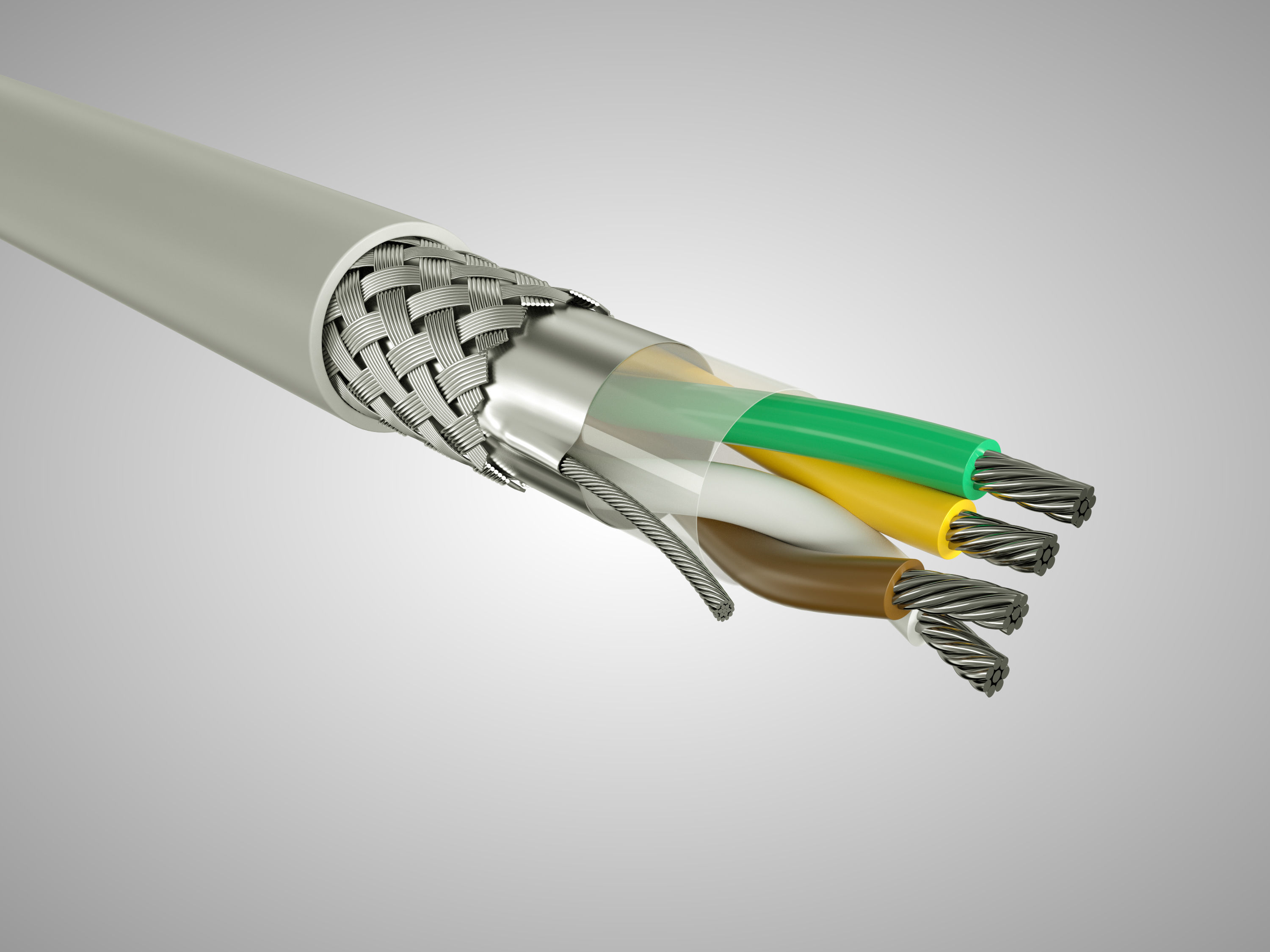
Braiding density refers to the percentage of cable surface covered by interlaced metallic wires in two opposite directions (left-hand and right-hand lay). The national standard formula is shown below:
\(P = (2p − p²) × 100\%\)
Where:
P — Braiding density
p — Unidirectional coverage factor (coverage ratio of braiding wires in one single direction)
A braid consists of two sets of metallic wires laid in opposite directions. Each set alone covers part of the cable surface (unidirectional coverage factor p). After superposition of the two sets, the braiding density P is formed. Since overlapping areas exist between wires of two directions, the braiding density is not a simple summation (2p), and overlapping parts shall be deducted, hence \(P = 2p − p²\).
Example: If \(p = 0.70\) (each wire set covers 70% of the surface independently):
\(P = (2 × 0.70 − 0.70²) × 100\% = (1.40 − 0.49) × 100\% = 91\%\)The resultant braiding density after superposition equals 91%.
3. Coverage Density (IEC 60092-350)
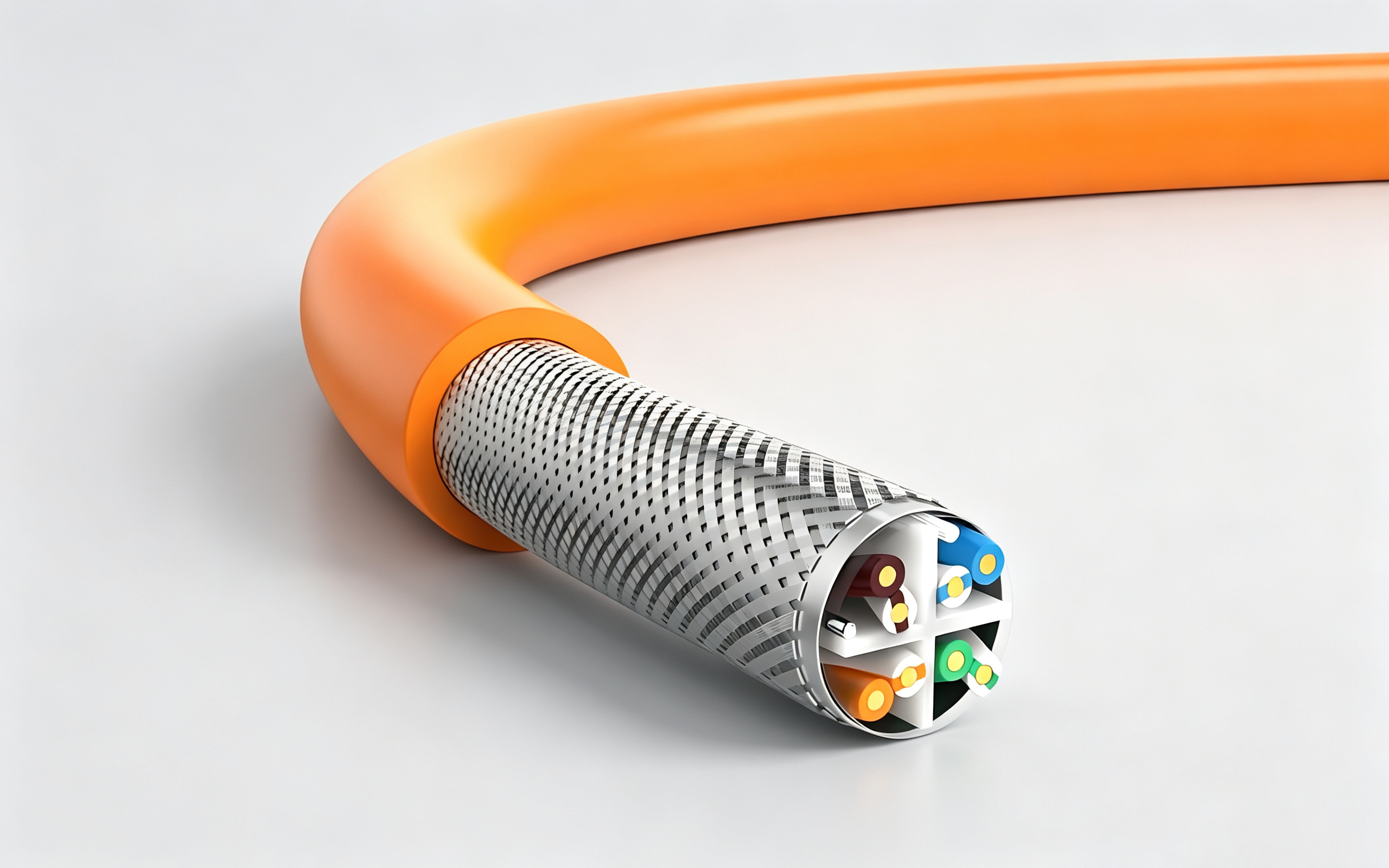
IEC 60092-350 adopts coverage density as the evaluation parameter, denoted by symbol G:
\(G = \frac{\pi × F × 100}{2}\)Where F stands for fill factor, calculated in the same way as the unidirectional coverage factor p in Chinese national standards, i.e. \(p=F\).
Note: \(p=F\), not \(P=F\) — final braiding density P is not equal to F.
When \(F=0.7\):
\(G = \frac{\pi × 0.7 × 100}{2} ≈ 110\)It proves that the value of G can exceed 100.
4. Calculation of Unidirectional Coverage Factor (\(p/F\))
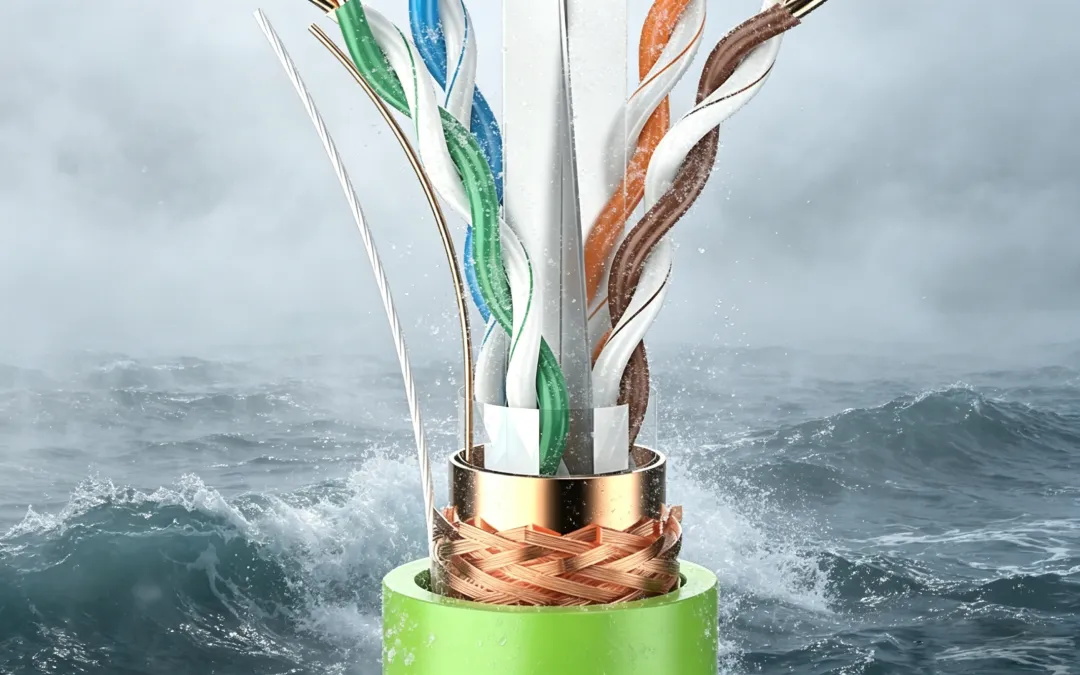
The unidirectional coverage factor p (namely fill factor F) is calculated by the formula below:
\(p = \frac{m × n × d}{\pi × D} × \sqrt{1 + \frac{\pi² × D²}{L²}}\)Where:
m — Number of carriers in one single direction of the braiding machine
n — Number of braiding wires per carrier
d — Measured diameter of braiding metallic wire, unit: mm
D — Measured outer diameter over braid layer, unit: mm
L — Measured braid pitch, unit: mm
During cable design, engineers do not directly set braiding density or coverage density. Instead, they adjust process parameters (wire diameter, carrier quantity, pitch, etc.) to control the unidirectional coverage factor (fill factor), and further determine the final braiding density or coverage density.Design flow:
Process parameters → Unidirectional coverage factor (\(p/F\)) → Braiding density P / Coverage density G
5. Engineering Application in Marine Cables
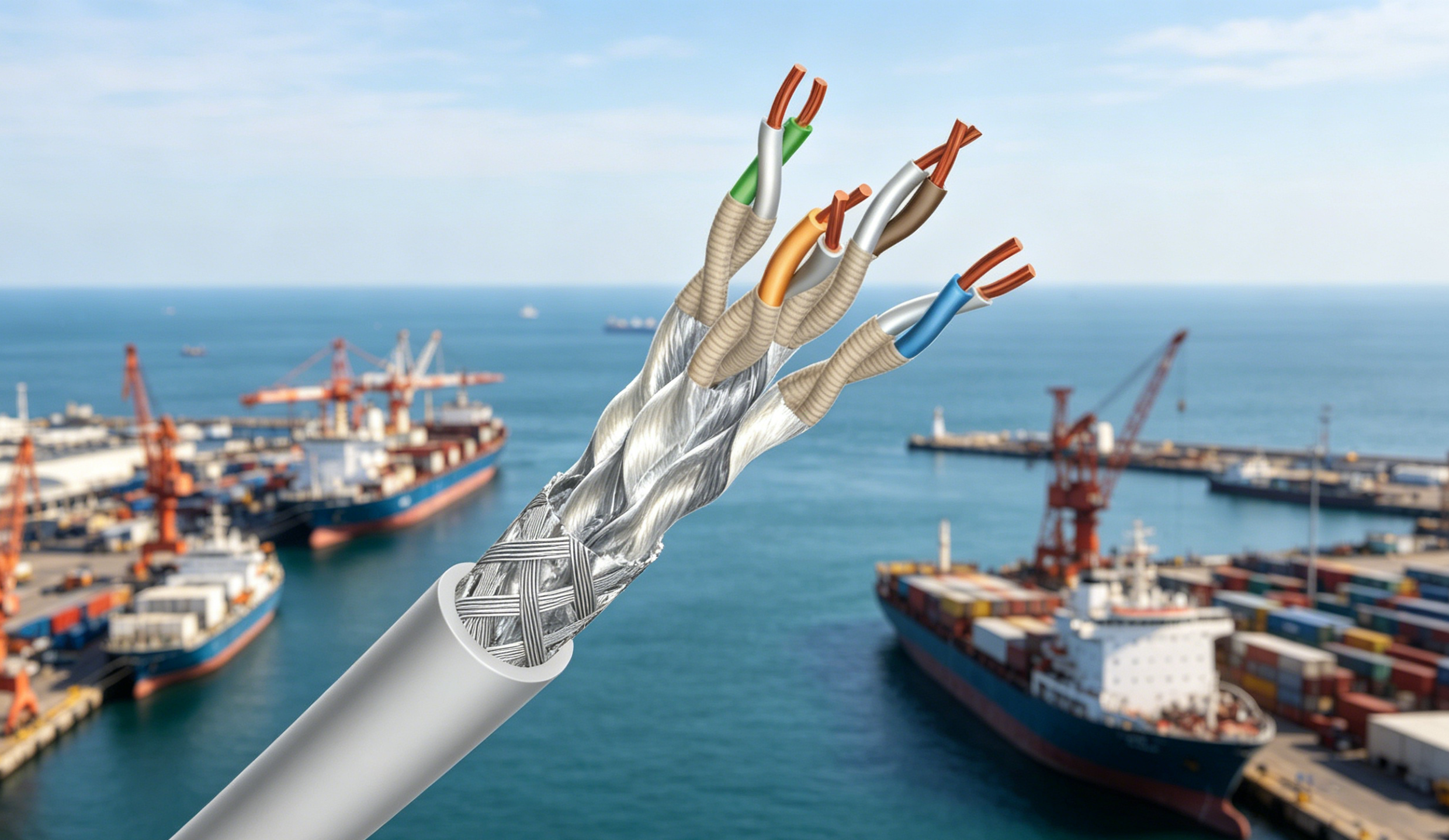
Within the marine cable sector, when customers mention “braiding density”, they generally refer to coverage density (coverage density) under IEC specifications.If a customer specifies “braiding density greater than 90%”, it normally requires coverage density \(G > 90\%\). Derived from the formula:
\(G = \frac{\pi F}{2} × 100 > 90 \quad → \quad F > 0.573\)Substitute into the national standard formula:
\(P = 2F − F² > 2 × 0.573 − 0.573² ≈ 81.8\%\)
Significant numerical differences exist under identical processing conditions across different standard systems. An IEC requirement of \(G ≥ 90\%\) roughly corresponds to a national standard braiding density \(P ≥ 82\%\).
The braided shielding layer and braided armour layer of cables provide both mechanical protection and electromagnetic shielding. Higher coverage density delivers stronger anti-interference performance and improved mechanical strength, yet increases material cost and reduces cable flexibility. Therefore, appropriate coverage density shall be selected according to working conditions and standard requirements during cable specification, instead of pursuing higher values blindly.
Post time: Jul-28-2026